
Abstract
This study examines Princess Ngọc Khoa (Bia Ut) in the collective memory of the Cham community, in relation to the reign of Po Rome (1627-1651) in Panduranga. Based on the Panduranga chronicles, the Nguyễn Phước genealogies, and oral traditions from Cham Bani villages, the research highlights how the Cham community accuses Princess Ngọc Khoa of executing political schemes under the orders of Chúa Nguyễn, using her beauty and intelligence to manipulate King Po Rome, weaken the royal court, and undermine the religious and political order of Panduranga.
By analyzing Bia Ut as a “political agent” under Chúa Nguyễn’s plan and as a symbol of the kingdom’s decline, the study demonstrates how the subjects of Panduranga personalized historical events, transformed them into moral symbols, and issued social warnings about foreign influence and threats to the stability of the royal order. The figure of Bia Ut both represents the political scheming of external powers and reinforces Cham cultural identity, reflecting the perspectives of Panduranga’s people on foreign interventions and the critical importance of safeguarding national order.
Keywords: Ngọc Khoa, Bia Ut, Panduranga, Po Rome, Cham legends, collective memory, political agent, state decline
1. Introduction
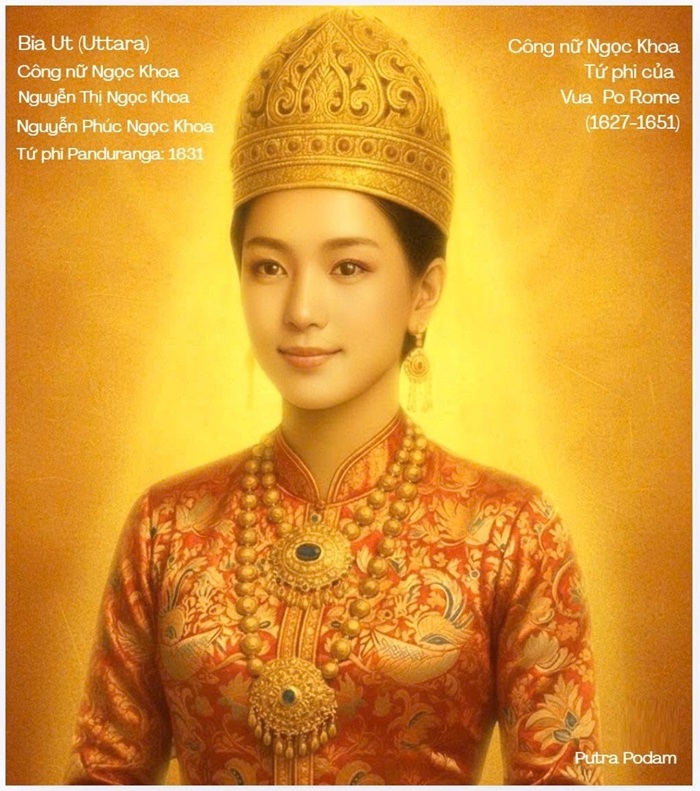
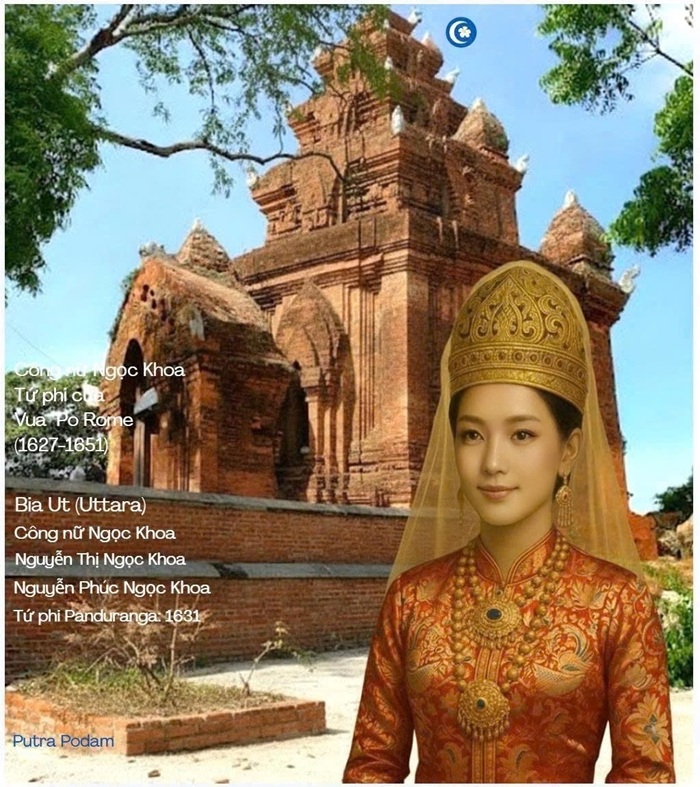
Princess Ngọc Khoa, in the memory of the Cham community, is often referred to as Bia Ut, and she is the central figure in many legends related to the reign of Po Rome (1627-1651) in the kingdom of Panduranga-Champa. Her full name, Nguyễn Thị Ngọc Khoa, identifies her as the maternal sister of Princess Ngọc Vạn and the third daughter of Lord Nguyễn Phúc Nguyên. In the Cham language, Bia Ut (from Sanskrit or Malay: Uttara, “North”) means “Northern Princess” or “Princess from Đại Việt.” According to the Nguyễn Phước genealogy, she was married to King Po Rome in the year Tân Mùi (1631), a politically significant union that placed her at the center of dramatic events and risks for the kingdom of Panduranga.
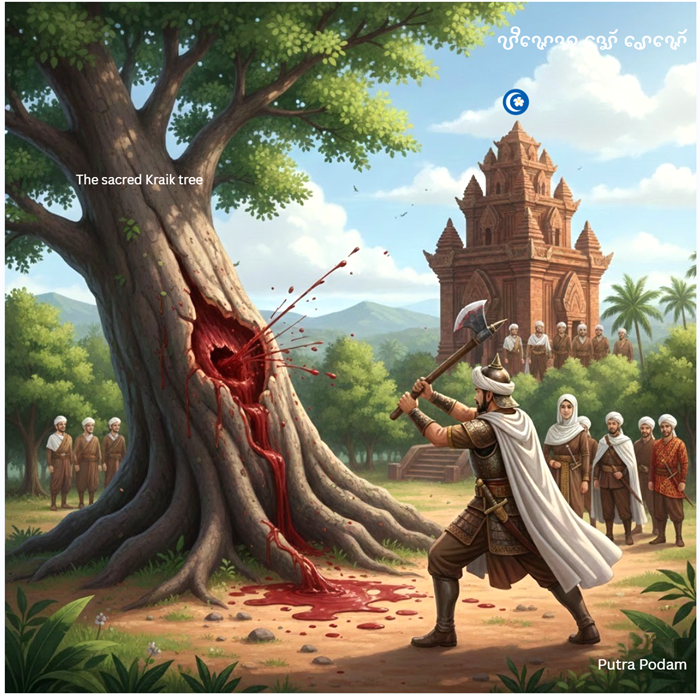
In Cham folklore, Bia Ut is remembered as a figure who executed political schemes under the orders of the Nguyễn lords, using her beauty and intelligence to manipulate King Po Rome, thereby weakening the royal court and disrupting the traditional religious and political order of Panduranga. Some legends recount that she urged Po Rome to cut down the sacred Kraik (krek) tree, a symbol of the divine power protecting the nation and upholding traditional order, which has been interpreted as contributing to the kingdom’s decline. Through these stories, the people of Panduranga transmitted lessons of vigilance against foreign plots, while emphasizing the importance of protecting national order, indigenous religious practices, and cultural identity from external political interventions.
This study analyzes the formation, function, and cultural significance of the legends surrounding Bia Ut, drawing on surveys of folk materials, the Panduranga chronicles, digitized archives, and academic research, in order to illuminate how Cham memory reflects and safeguards the perspectives of the Panduranga people regarding history and power.
2. Historical and Social Context of Panduranga under the Po Rome Reign
The reign of Po Rome (1627-1651) occurred during a period when Panduranga faced numerous political, military, and cultural challenges. This kingdom, located in the regions corresponding to modern-day Ninh Thuận, Bình Thuận, Đồng Nai, and part of Lâm Đồng provinces, became a crossroads for foreign forces and political pressures. According to the Panduranga Chronicles (Sakkarai dak rai patao) and the Kelantan royal genealogy, Po Rome is recorded as a monarch with flexible diplomatic skills, yet he simultaneously had to maintain internal order through rituals, traditional beliefs, and relations with local chieftains. He faced pressures from Lord Nguyễn in Đàng Trong, Malay-Islamic merchants and envoys, and internal conflicts, making Panduranga a politically and culturally risky buffer zone.
In the memory of the Panduranga people, the royal court’s encounters with foreign influences posed an internal threat: external elements could penetrate not only the culture but also governance through individuals, particularly via political marriage alliances. Princess Ngọc Khoa (Bia Ut), the third daughter of Lord Nguyễn Phúc Nguyên, who was married to Po Rome in the year Tân Mùi (1631), became a living symbol of this threat. The people of Panduranga saw her both as a foreign princess and as a representative of Lord Nguyễn’s political schemes, capable of manipulating the royal court from within.
In Cham society, indigenous beliefs played a foundational role, reinforcing royal authority and preserving social order. Court rituals and spiritual symbols, such as the sacred kraik tree, were regarded as embodiments of yang, the divine force protecting the kingdom. External interference, particularly through foreign individuals within the court, was collectively remembered as causing an imbalance between local tradition and outside influence, leading to crisis and decline. Within this context, Bia Ut became the focal point of legends of betrayal, where her beauty, intelligence, and foreign status were seen by the Cham community as tools for Lord Nguyễn to manipulate Po Rome, resulting in decisions that weakened the nation.
The legends of Bia Ut not only emphasize individual agency but also reflect the moral perspective and social warnings of the Panduranga people: the king’s folly, the reliance on outsiders over tradition, and the consequences of disrupting religious order. These stories serve both as moral lessons and as a means for the Cham community to personalize historical events while denouncing Lord Nguyễn’s role through the placement of Bia Ut in the court as a form of internal espionage.
This political, social, and religious context explains why Bia Ut occupies a central position in legends of betrayal, personal tragedy, and symbolic representation of decline. Folk narratives reflect the Cham people’s views on collapse and internal conflict, while emphasizing the relationship between power, religion, and cultural identity, and highlighting the infiltration of foreign influence through the figure of Bia Ut in the ongoing maintenance and defense of Panduranga under the reign of Po Rome.
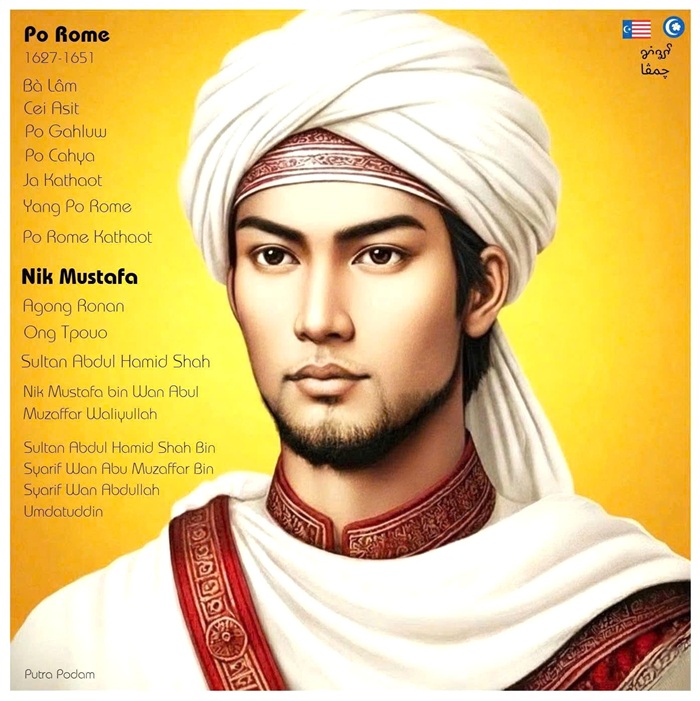
Figure 2. King Po Rome (Nik Mustafa, Sultan Abdul Hamid Shah, Nik Mustafa Bin Wan Abul Muzaffar Waliyullah). Po Rome (reigned 1627-1651) was a Panduranga-Champa king who followed Islam, succeeding the reign of Po Klong Mah Nai (Po Mah Taha), also a powerful Islamic ruler of Panduranga. Queen Sucih (Bia Sucih or H’bia Than Cih) was the daughter of King Po Klong Mah Nai, and the secondary queen Than Chan (H’bia Than Can) was the daughter of a Rhade (Degar, Ede) chief, Princess H'Drah Hajan Kpă, meaning “Rain County Princess.”
During Po Rome’s time in Makkah, referred to by the Malays as Serembi Makkah, corresponding to the Kelantan Sultanate (Malaysia), he married the Islamic princess Puteri Siti (Princess Siti). This officially established his status as a member of the Islamic royal lineage in Malaysia. Malaysian chronicles record that the current ruling line in the Kelantan Sultanate descends from King Po Rome.
3. The Legend of Bia Ut as an Insider in Cham Memory
According to the people of Panduranga, Princess Ngọc Khoa (Bia Ut) appears as an insider, allegedly placed in the Panduranga court by Lord Nguyễn Phúc Nguyên to carry out political schemes, manipulate King Po Rome, and weaken the kingdom from within. This memory has been passed down through folk legends to later generations to explain the causes of the dynasty’s collapse and to express strong criticism of foreign interference in the royal court.
According to popular legends in the palei Cham of Bình Thuận and Ninh Thuận provinces, Bia Ut used her beauty and intelligence to seduce King Po Rome, causing him to act foolishly and make decisions seen as undermining the spiritual and political foundations of the kingdom. Most prominently, she persuaded the king to cut down the sacred kraik tree, a vital symbol in Cham religious belief, embodying yang, the divine force protecting the nation and maintaining royal order. In Cham discourse, this act is regarded as a deliberate political plot, allegedly driven by Lord Nguyễn from the outside, disregarding moral obligations and the marital bond between Bia Ut and Po Rome. The involvement of a foreign female in this act was perceived by the people of Panduranga as a betrayal of both the kingdom and the royal family, and as evidence of Lord Nguyễn’s political manipulation.
The consequences of this insider act are clearly depicted in the legends: after the sacred tree was cut down, Panduranga fell into defeat, chaos, and lost divine protection. In Cham memory, this image transcends religious meaning and becomes a political metaphor, symbolizing the fracture of social order, the weakening of royal power, and the kingdom’s strategic failures. Bia Ut thus becomes the central figure accountable for the national tragedy, both a symbol of folly and foreign influence, and a reflection of King Po Rome’s failure to maintain connection with the traditional spiritual order.
Some oral variants recount that after Po Rome’s death, the people of Panduranga punished Bia Ut by “forcing her head into the mud until death.” Although this form of punishment is not confirmed by contemporary sources or archaeological evidence, it reflects a form of public humiliation and expulsion from the community, while sending a strong moral message: a warning about the dangers of insiders and foreign influence. Other versions describe Bia Ut later being represented in statues “with her head in the mud,” symbolizing disgrace and reminding future generations of the consequences of political schemes and royal folly.
From the perspective of empirical history or Cham stone inscriptions, there is no evidence that Princess Ngọc Khoa was a spy. Nevertheless, the legend has persisted to explain historical events during that period. Bia Ut, as a foreign female executing a political seduction strategy, was interpreted by the people of Panduranga as a historical tragedy and as a cautionary symbol against Lord Nguyễn’s political schemes, emphasizing the importance of maintaining order, religious practice, and cultural identity within the court.
The story of Bia Ut reflects how the Cham community remembers and interprets historical events: they transform complex occurrences into comprehensible narratives tied to moral and cultural lessons. In this process, foreign women were often portrayed as agents of disruption, both to explain past events and to warn future generations of the dangers of outside influence and political manipulation. Bia Ut, therefore, is not merely an individual in oral tradition but becomes a symbol denouncing the political schemes of Lord Nguyễn Phúc Nguyên, while also illustrating how the Panduranga community perceived and actively sought to protect the court from internal threats within the royal family.
4. Princess Ngọc Khoa and the Symbol of Panduranga’s Decline
Princess Ngọc Khoa, commonly known among the Cham community as Bia Ut, emerges prominently in Cham memory and oral tradition related to the reign of Po Rome (1627-1651) in Panduranga. According to the Nguyễn Phước genealogy and the Panduranga chronicles, she was the third daughter of Lord Nguyễn Phúc Nguyên and was married to Po Rome in the year Tân Mùi (1631) to serve a clear political purpose: to strengthen Lord Nguyễn’s influence in Panduranga [Nguyễn Phước tộc Thế phả, 1967]. Many palei Cham Bani emphasize that, through her beauty and intelligence, Bia Ut had a profound influence on Po Rome, guiding him to take actions viewed by the Cham community as contrary to traditional religious practices and courtly order. The most notable act was persuading the king to cut down the sacred kraik tree, a symbol of yang, the kingdom’s divine protective force, and a pillar of political and social stability. In Cham memory, this event is not merely a personal decision but is regarded as a symbol of fractured identity, the imbalance between indigenous elements and foreign influence, and the first sign of the court’s weakening and potential internal crisis [K. R. Hall, 2000].
In Cham folklore, Bia Ut is also referenced in the proverb “Limâk yau Bia Ut” (“Fat as Bia Ut”), reflecting extravagance, susceptibility to corruption, and implicitly pointing to foreign influence that could destabilize the nation [Phan Thanh Hải, 2012]. These stories illustrate how the Cham community observed and evaluated foreign intrigues: they viewed Bia Ut as a representative figure of an insider, warning of the consequences of trusting outsiders while neglecting indigenous beliefs. Details of her urging the king to cut the sacred tree or intervening in other major decisions show how the people of Panduranga translated complex events into comprehensible images, both explaining history and educating future generations about morality, political vigilance, and the protection of national identity.
The figure of Bia Ut in Cham memory also reflects the close relationship between political power, religious belief, and gender roles. She became a symbol of the danger posed when foreign elements penetrate the royal order. Recognizing Bia Ut’s role in political events from political marriage to the act of cutting the sacred tree illustrates how the Cham community interpreted and responded to insider threats, while reinforcing awareness of territorial protection, identity, and autonomy in Panduranga [H. Maspéro, 2001]. Consequently, the oral tradition of Bia Ut is not merely a story about an individual but a cultural and political symbol, reminding people of the importance of vigilance toward foreign powers, maintaining courtly order, and preserving the kingdom’s traditional values.
Overall, the image of Bia Ut has been preserved and developed in Cham oral tradition, becoming a focal point in how they remember, evaluate, and educate about historical events. She not only reflects the political machinations of foreign powers but also exemplifies the relationship between authority, belief, and culture in the formation and defense of Panduranga’s national identity. Bia Ut, therefore, is both a figure who exposes political intrigue and reinforces the community’s awareness of foreign threats, contributing to the stability and cultural identity of late Champa.
5. Conclusion and Research Significance
The study of Princess Ngọc Khoa (Bia Ut) in the Cham community’s memory, in relation to the reign of Po Rome, shows that the legends about her reflect the political and social awareness of the people of Panduranga. According to the Panduranga chronicles, the Nguyễn Phước genealogy, and oral traditions, Bia Ut was allegedly placed in the Po Rome court by Lord Nguyễn Phúc Nguyên to carry out political schemes, using her beauty and intelligence to manipulate the king and push him to undertake acts that endangered the kingdom’s sacred pillars, most notably the felling of the kraik tree, a symbol of political authority and social stability. These stories clearly denounce foreign political schemes and highlight the dangers that arise when the Panduranga court is not vigilant against external intrusions.
The legends of Bia Ut were used by the Cham as tools for social education and caution. They emphasize the responsibility to protect indigenous religious, political, and cultural order, while warning of the consequences of manipulation by foreign powers. Although some folk details, such as “forcing her head into the mud,” lack material evidence, they reflect a consciousness of protecting social order and communal outrage toward actions that could bring national ruin.
Research on Bia Ut demonstrates how the Cham community responded to foreign schemes, maintained cultural identity, and protected the royal court. The legend educates younger generations about morality, vigilance against foreign influence, and the importance of safeguarding religion, cultural identity, and political order to ensure Panduranga’s prosperity and stability. Consequently, Bia Ut becomes a symbolic warning of political danger and an emblem of the people of Panduranga’s pride and sense of responsibility toward the kingdom’s security.
Liên kết (Links)
1. Putra Podam, Po Rome: Nhà vua của hai thế giới-Champa bản địa và Islam Mã Lai
2. Putra Podam, Po Rome vị vua Panduranga dòng dõi Churu Hồi giáo-Islam
3. Putra Podam, Một số tên gọi vị vua Po Rome
4. Putra Podam, Một số hoàng hậu, thứ hậu của vua Po Rome
5. Putra Podam, Công chúa H'bia Hadrah Hajan tộc Rhade trở thành thứ hậu Bia Than Chan
6. Putra Podam, Awal và lịch sử Islam tại Champa
7. Putra Podam, Awal: Hệ phái Hồi giáo Champa
8. Putra Podam, Agama Awal (Bani Awal) là hệ phái tôn giáo của Champa
9. Putra Podam, Awal-Ahier là: Hồi giáo của vương quốc Champa
10. Sakaya, Ahier là Islam giáo sau - Awal là Islam
11. Kelantan: http://www.royalark.net/Malaysia/kelant2.htm
12. Video tháp Po Romé: http://youtu.be/5Gz-ccSM8rY
Tài liệu tham khảo (References)
1. Wong Tze Ken, D. (2004). “Vietnam-Champa relations and the Malay-Islam regional network in the 17th-19th centuries”. In P. Manguin (Ed.), “The Introduction of Islam into Champa”. (pp. 1-28). Singapore: Institute of Southeast Asian Studies.
2. Ferlus, M. (2002). “Les Chams de Panduranga: Linguistique et histoire”. Paris: CNRS Éditions.
3. Hardy, A. (2009). “Histories of Champa and Panduranga”. Bangkok: Silkworm Books.
4. Maspero, G. (2002 [Original work published 1912]). “The Champa Kingdom”. Bangkok: White Lotus Press.
5. Nakamura, R. (2010). “Cham historical chronicles and political symbolism”. Journal of Southeast Asian Studies, 41(3), 423-445.
6. Nguyễn Phước Tộc. (2015). “Thế phả Nguyễn Phước: Gia phả Chúa Nguyễn”. Huế: Nhà xuất bản Thuận Hóa.
7. Po Dharma, C. (2007). “Le Panduranga: Histoire et traditions Cham”. Paris: L’Harmattan.
8. Trần, Q. M. (2011). “Truyền thuyết Cham về Bia Ut và triều đại Po Rome”. Tạp chí Nghiên cứu Văn hóa Dân gian, 3(12), 45-63.
9. Woodside, A. (1988). “Vietnam and the Southeast Asian frontier: Expansion and control in the early modern period”. Cambridge: Cambridge University Press.
10. Zottoli, B. (2012). “Cham and Malay in 17th-century Southeast Asia: Political intrigue and cultural exchange”. Journal of Asian History, 46(2), 189-214.
11. Biên niên sử Panduranga (Sakkarai dak rai patao), bản sao số hóa, Viện Nghiên cứu Champa, Việt Nam.
12. Po Dharma. (2013). “Vương quốc Champa: Lịch sử 33 năm cuối cùng (1802-1835)”. Champa.one.
13. Po Dharma, C., & cộng sự. (2018). “Tài liệu Hoàng gia Champa / Royal Archives of Champa”. Champa.one.
14. Durand, E. (1971). “Les archives des derniers rois chams”. Institut d’Asie Orientale, France.
15. Southworth, W. A. (2022). “Champa. In G. Coedès & M. Cœdès (Eds.)”, The Oxford Handbook of Early Southeast Asia. Oxford University Press.
16. Bài viết “Champa: vương quốc đa dân tộc.” (2015). Nghiên cứu lịch sử.
17. Cộng đồng nghiên cứu Nghiên Cứu Lịch Sử. (2018). “Khảo sát tín ngưỡng, Palei Bani và truyền thống Cham”. Nghiên cứu lịch sử.
18. Lương, N. (2015). “Tổng quan về lịch sử Champa”. Diễn đàn Nghiên cứu lịch sử.
19. University of Chicago Press. (2011). “The Cham of Vietnam: History, society and art”. Chicago: University of Chicago Press.
20. Tân, P. (2024). “Đại Việt and Champa: Panduranga, Kauthara, and Indrapura”. Nghiên cứu Lịch sử. Truy cập tại: https://nghiencuulichsu.com/2024/11/26/sach-ve-dai-viet-and-champa-bang-tieng-anh/